City Chain
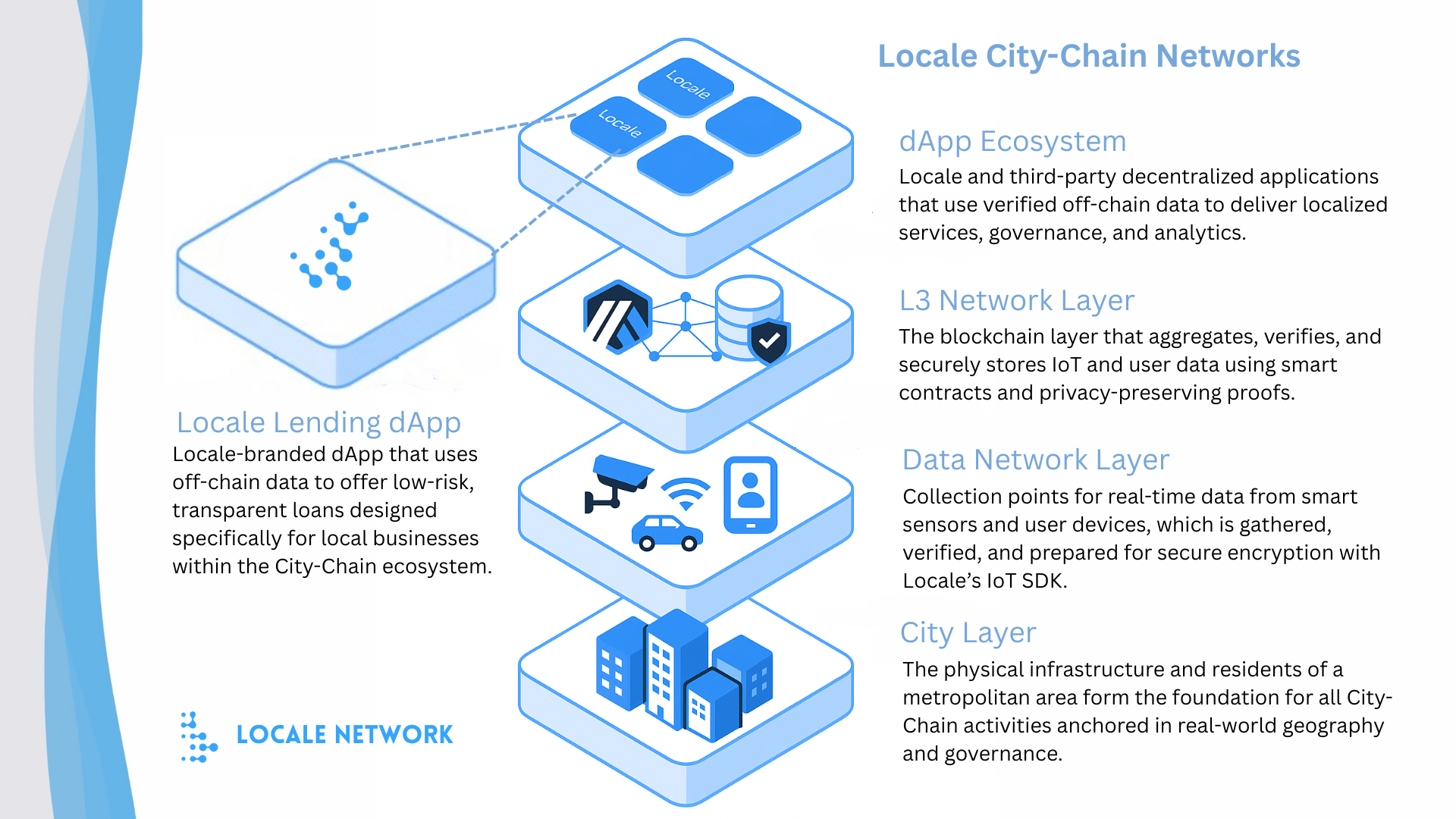
City Chain is a dedicated Layer 3 (L3) rollup for your city or community. Each City Chain settles to Locale Network (L2), which in turn settles to Ethereum Mainnet—inheriting full Ethereum security.
What is City Chain?
City Chain is a geographic blockchain tailored to serve a specific city, region, or community. Unlike general-purpose blockchains, City Chains are designed with local governance, local economics, and local data sovereignty in mind.
- DAO voting
- Proposals
- Treasury
- Mint/burn
- Reserves
- Payments
- L{CORE}
- IoT attestations
- Privacy
Key Features
Local Sovereignty
Communities control their own blockchain:
| Control | Description |
|---|---|
| Governance | Local stakeholders vote on protocol changes |
| Economics | Transaction fees stay in the community |
| Data | Sensitive local data remains under local control |
| Upgrades | Communities decide when and how to upgrade |
High Performance
Optimized for local use cases:
- ~2 second block times — Near-instant finality
- Low gas costs — Fraction of mainnet fees
- High throughput — Thousands of TPS capacity
- Custom gas tokens — Pay fees in local currency
Ethereum Security
Inherits the full security of Ethereum:
- Fraud proofs — Invalid state transitions can be challenged
- Data availability — Transaction data always accessible
- Censorship resistance — No single point of failure
- Finality — Settles to Ethereum's proven consensus
How It Works
1. Transaction Submission
Users submit transactions to the City Chain sequencer through any EVM-compatible wallet.
| Step | Action |
|---|---|
| Connect | Connect wallet to City Chain network |
| Sign | Sign transaction with your private key |
| Submit | Send to sequencer for ordering |
2. Sequencing & Execution
The sequencer orders transactions and produces blocks:
Transactions → Sequencer → Block Production → State Updates
3. State Commitment
State roots are periodically posted to Locale Network:
City Chain State Root → Locale Network (L2) → Ethereum
4. Dispute Resolution
If anyone detects invalid state, they can submit a fraud proof:
Invalid State Detected → Fraud Proof Submitted →
State Rolled Back → Malicious Actor Slashed
Live Networks
| Network | Chain ID | Status | Explorer |
|---|---|---|---|
| KC Mainnet | 418 | Coming Soon | — |
| KC Testnet | 4181 | Live | explorer.testnet.kc.locale.cash |
Use Cases
Municipal Services
- Permit payments — Pay city fees on-chain
- Voting — Transparent local elections
- Public records — Immutable document registry
- Transit — Integrated fare payments
Local Economy
- Local currency — Community-backed digital money
- Merchant payments — Instant, low-cost transactions
- Loyalty programs — Programmable rewards
- Microtransactions — Sub-cent payments enabled
Community Data (Powered by L{CORE})
City Chain integrates with L{CORE} for verifiable IoT data:
- IoT integration — Sensor data attestation via L{CORE}'s decentralized infrastructure
- Environmental monitoring — Air quality, noise, traffic with cryptographic provenance
- Public dashboards — Transparent community metrics backed by device signatures
- Data marketplace — Residents monetize verified sensor data
L{CORE} ensures that all IoT data on City Chain is cryptographically verified—every sensor reading is signed by the device and attested through Reclaim Protocol's TEE infrastructure.
Getting Started
For Communities
For Developers
For Users
Technical Specifications
| Parameter | Value |
|---|---|
| Block Time | ~2 seconds |
| Gas Limit | 30M per block |
| Native Token | ETH (bridged) |
| VM | EVM-compatible |
| Consensus | Sequencer + Fraud Proofs |
| Data Availability | Locale Network DA |
Next Steps
We're working with select cities and communities for early deployments. Contact us to discuss bringing City Chain to your community.